


Week 6: Texture Map Baking, Retopology
- Manan Sarkhedi
- Dec 14, 2022
- 2 min read

This week was about learning Retopology, which is the process of converting high-resolution models into something much smaller that can be used for animation.
Why retopologize To make a clean topology and an edge flow that works for an organic model because, if the model is going to be rigged and animated it needs to have proper topology so that it deforms in the way it is supposed to while maintaining the volume. Retopology also reduces polycount and makes sure the areas that need more deformation get a higher polycount and when you increase the subdivisions the topology is still clean.

Zones of deformation
There are certain places with higher deformation than the others like the lips, the nostrils and the eyes that need more subdivisions. So it is recommended to learn anatomy and plane changes.
Also we need quads as they help with clean edge loops. Another thing to be careful of was the topology near joints to make sure they can bend properly.

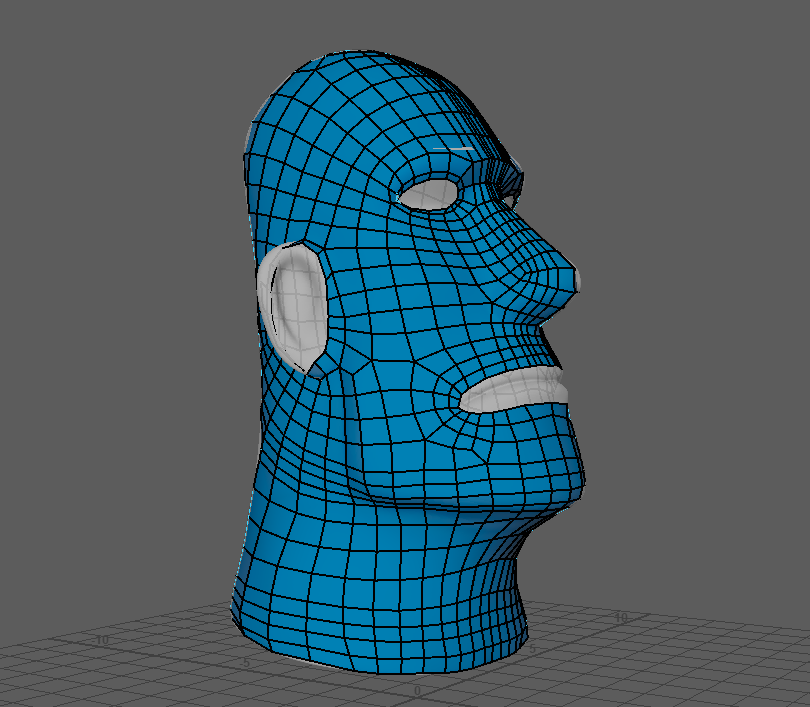
I used the live surface tool to begin retopologizing and using the Quad draw tool I added faces near the eyes, ears and lips first and then I started adding faces. Also I learnt about working with symmetry on. Richard said that working on retopology was like working on a puzzle and I agree with him but it is a really boring puzzle.
I did make a lot of mistakes in this first model. I didn't know about symmetry so I randomly started making faces and redid the face again. I also didn't start with big faces so I ended up wasting time with my small faces. The edge flow for the model was also not very well done.
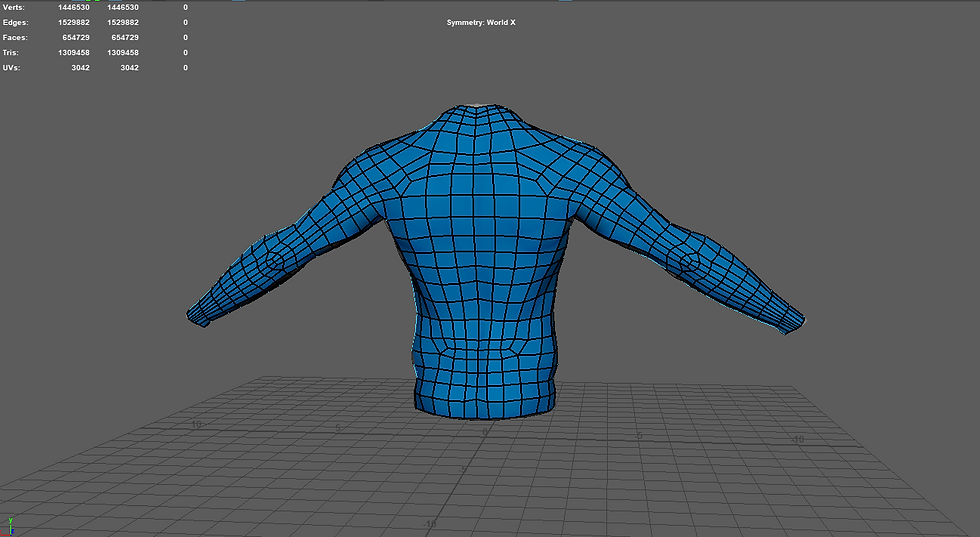
So for the next model I did the torso from the canvas. It was a relatively simple model that gave me a general idea of retopology. And this time I started with the big faces and added edge loops only where necessary. I added the edge loops to the chest and near the shoulders and went ahead from there. I knew a little bit about edge flow rerouting but doing it during the exercise gave me an idea of how to do it. I also learnt about dealing with the joints like the elbows.
Self critique - I followed this one almost step by step and did everything Richard did so there isn't much to critique in this one but I could... sorry can't think of anything to improve on this one.

But then it was the baby's turn to get retopologized. This was when I had problems, mainly with the edge flow. The thing about retopology is you don't know when its wrong until you understand what's right. So I made the face and had to make a lot of changes with the edge flow near the eyebrows and ears after seeing Richard's model and his logic behind doing this.


Self critique - This baby has some issues near the nose. There are a lot of edge loops there, and even a couple of tris, which I didn't notice until writing this blog. Maybe it can even
Retopology is an interesting, important yet really boring part of the workflow.
Comments